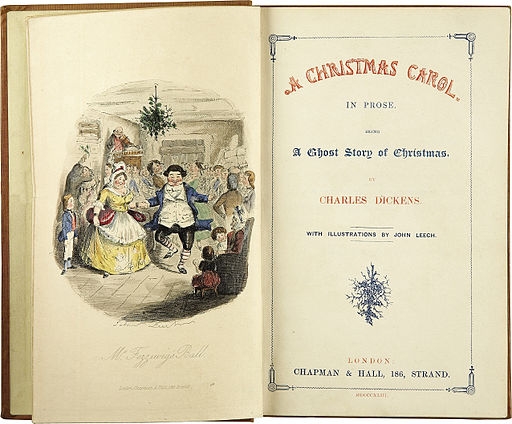
The holiday season is upon us again and I thought this year I would get in the mood by listening to Charles Dickens a Christmas Carol. I’ve recently started listening to audiobooks and it’s a super convenient way of consuming books and information when you’re on the move. I’ve never read or listened to a Christmas Carol but have seen the film and play, and like us all have been exposed every Christmas for as long as I can remember. Listening to the book Tools of Titans by Tim Ferriss, he had a section called The Dickens Process – What are your Beliefs Costing You? This started me thinking about how the story relates to golf?
I made a brief synopsis in my head of the story. The first thing that came to mind was the ghosts of Christmas past, present and future. Immediately I coupled this with Pia Nilsson & Lynn Marriott’s ideas on the think box, the play box and the memory box, outlined in their super book Be a Player. A Breakthrough Approach to Playing Better on the Golf Course (75). However, when listening to the book I found it offered much more than had first met my eye.

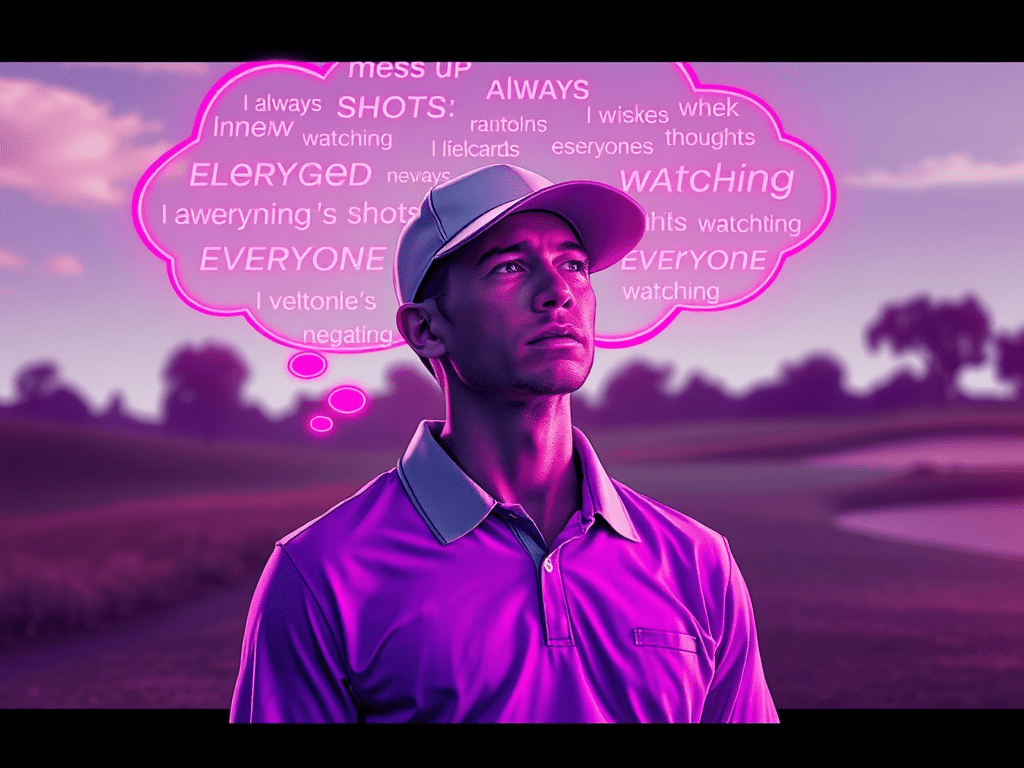
I settled into listening to the book and the first ghost to visit Scrooge is the Ghost of Jacob Marley, Scrooge’s old business partner. Marley had been much like Scrooge, engrossed in the business at making money at all costs. He appears clad in chains and bound with bandages. Marley is full of repent from his awful ways when on the earth, but death has brought him to terms with his mistakes and misgivings. He says to Scrooge, “I made my chains from my own free will.” This is so in tune with how many of us act on the golf course, bound with anxiety, fear and anger. Marley goes on to say that he is, “travelling with no rest, no peace, incessant travel of remorse.” We truly bind ourselves in chains at times. Focusing and practising playing without chains has been something I’ve had to work on over the past years and for the benefit of my game and my mental health on the golf course.
The light bulb moment for me came when listening to the ‘On the Mark’ podcast hosted by Mark Immleman, in an episode with Dr Kapil Gupta on Conquering the Mind to Achieve Greatness (28th July 2017). They talk about anxiety on the golf course and discuss our wants and needs. We all want to do well and this is what causes us the anxiety, but Dr Gupta explains that “need is a prison, whatever you need, even if you get it, the price you would have paid for having gotten it, isn’t worth the getting of it, because you will live in angst the entire journey.” This hit true for me and must do for some of you. When that last put goes in on 18, it’s often just relief that the round is over, that you made it past the finish line. For me I didn’t want golf to be like that, I was on the course to enjoy myself I thought, but more importantly the fear and anxiety weren’t really helping me play to my full potential, in essence, I was bound in chains I made from my own fee will like Marley. In addition knowing that even if I did manage to navigate the chains and post a good score, it really wasn’t going to be worth it as the experience was torture most of the time.

Carl Morris and Gary Nicol highlight in their book The Lost Art of Playing golf that the questions we ask ourselves are vitally important (21). So ask yourself, What makes you happy about your golf? What state of mind do I perform best in? Carl Morris often talks about the quality of questions we ask ourselves help define us. Battling to remove the chains we place on ourselves is worth taking the time to investigate. Losing them is liberating and can be the difference between enjoying a good round or hating it. Fred Shoemaker in his book Extraordinary Golf had the quote that made a huge difference for me in removing anxiety and fear from my game. I still have the quote on an index card in my bag and I read it before every round and every time I feel tension, it goes like this:
“When your more interested in letting go than the quality of your shots, the quality of your shots will amaze you.” (Fred Shoemaker)

So next round just try to let go, remove the chains and see how it goes. I assure you, even if you don’t score better you will feel freer and that is worth more than a good score, and when the good score does come it will be effortless and therefore much more valuable and repeatable.

Back to A Christmas Carol. Next, the Ghost of Christmas Past shows up. He takes Scrooge on a trip to his childhood, which really makes Scrooge reflect on a better time. A time when he was young free and happy. Morris and Nicol suggest we all do the same with our histories in golf. What is your story? They suggest looking back to the beginning to unlock answers. Ask yourself: How did it all start for you? What drew you to the game in the first place? How did your relationship begin? Who got you started (22)? Like Scrooge, you will find that things began for the purest of reasons. Somewhere in the past lie answers to problems your attitude may face on the course today. Scrooge weeps at his former self. If this is you then your attitude needs a change, reunite with your inner child.
The Ghost of Christmas past also reminded me of what Nilsson & Marriot call the think box. “The think box is the period of time before the shot… that is characterized by analytical thought (Nilsson & Marriot 73).” This is the time when we do our calculations, look at the lie, assess the wind, get our yardage, evaluate where we want our ball to land and how we will achieve this. Players tend to spend too much time in their think box and this can lead to second-guessing. I have a structured plan for my think box. Before I play I take note of the wind speed and air temperature using the weather app on my phone. These have small incremental effects on the ball. I first nail my yardage using a laser or course planner. I then check the wind direction. I then check the lie. I then look at where the danger is. Shooting low scores isn’t about making more birdies, it’s about avoiding big numbers. I then take a tip I heard from Nick Faldo. He asks himself before every shot, “What do I want? What can I get?” I then pick a safe target and commit to it 100%. Now due to shot dispersion, I often pull or push the ball away from this target, sometimes resulting in a great shot that lands really close, or further from the pin than I wanted. However, if I miss on the fat side of the pin my chances of getting down in two increase significantly. Work on your think box, have a plan, it reduces the chances of having to make things up on the go.
After the Ghost of Christmas past is done with Scrooge the Ghost of Christmas present shows up. This made me think of Nilsson & Marriott’s play box. “The play box is the time and space over the ball in which you execute the shot.” They go on to say, “it’s a sensory state in which for instance your feeling a low centre of gravity or visualizing the ball flight (73).” In the play box, you want to be free-flowing and not thinking analytics. You don’t want to be thinking too many swing thoughts. I like to grind some things out on the range then settle on one swing thought for the round. I then stick with that for the round and never change it. If the ball is going wayward, I may open or close the clubface at address, or aim further right or left to solve ball direction problems. If I have strike problems, I may move the ball forward or back to deal with fat or thin strikes (low-point) or strike the ball off the toe or heel to find the feeling of the sweet spot. Changing swing thoughts mid-round doesn’t wield great results. So save those changes for the range. Get yourself a pre-shot routine and stick with it for the entirety of the round.
My other take from the visit of the Ghost of Christmas present is that you should try to be in the present while playing golf. Stick to the shot at hand. The old cliche of ‘one shot at a time’ really does hold weight. But just thinking it doesn’t cut it. You need to really work on this. I have to catch myself when thinking about how I’m going to birdie 16, 17 & 18 to shoot a score. We all do it, it’s about training the ability to reel this back and get back to concentrating on the shot at hand. Once more pre-shot routines and following the process is vital here.
Scrooge’s final meeting is with the Ghost of Christmas Future. He is the most frightening of ghosts and represents death. Morris & Nicol start their book with a story about, “The Tuesday Boys (14).” It’s a story about a plaque on a bench on a golf course in the UK dedicated to 4 golfers called the Tuesday Boys. They lament on how many rounds this four-ball must have played over the years and that eventually one by one there were no more Tuesdays left and sadly no more Tuesday Boys. They link this to the skill of gratitude and say there is strong evidence to suggest that the skill of gratitude is closely linked to the quest for the feel-good factor in ourselves (Morris & Nicol 15). Our days are limited so try and appreciate your time out there.
Nilsson & Marriots final box is the Memory Box. This is your post-shot process, where they suggest you store your good shots and remain neutral to negative shots (73). It’s worth taking time before your round to have a think about your memory box and how you plan to react to your shots. All too often we accept good shots as if they were our god-given right and our bad shots like a raging banshee. There’s one thing for sure, you’re not getting any of those shots back, so you might as well accept them and move on. Nilsson & Marriot suggest having 3 categories for your shots. Great, good, good enough and moving on. I like to recreate the correct feel from the swing or chip and move on. I also find the breathing technique of breathing in for 4 seconds, holding it for 4 and breathing out for 5 helps me limit negative self-talk and settle my pulse rate from raging to resignation.
The Three Ghosts of Christmas do a wonderful job on Scrooge and as we all know he sorts his game out after their visit. I hope some of this advice can help sort your game out. Thanks for reading.
This has been my first blog post. I’m a qualified PGA Assistant Coach and former NCCA Division 1 Golfer at Coastal Carolina University. I grew up in Cwmbran, South Wales and now live with my wife and 3 children in Stockholm, Sweden. For online lessons please see my website, I’d love to be able to help your game out so you can play your best ball.
Works Cited
Dickens, Charles. “A Christmas Carol.” The Telegraph, Telegraph Media Group, https://books.telegraph.co.uk/Product/Lesley-Sims/A-Christmas-Carol–Usborne-Young-Reading-Series-Two/16462064.
Ferriss, Tim. “Tools of Titans: The Tactics, Routines, and Habits of Billionaires, Icons, and World-Class Performers: Amazon.co.uk: Ferriss, Tim: 9781713579526: Books.” Tools of Titans: The Tactics, Routines, and Habits of Billionaires, Icons, and World-Class Performers: Amazon.co.uk: Ferriss, Tim: 9781713579526: Books, Audible, 2020, https://www.amazon.co.uk/Tools-Titans-Billionaires-World-Class-Performers/dp/1713579529.
Nicol, Gary, et al. The Lost Art of Playing Golf: Reconnect with the Game You Fell in Love With. Sports Publications Limited, 2019.
Nilsson, Pia, Marriott, Lynn. Be a Player: A Breakthrough Approach to Playing Better on the Golf Course. Atria Books, 2017.
Immleman, Mark. “On the Mark Golf Podcast: Dr. Kapil Gupta on Conquering the Mind to Achieve Greatness on Apple Podcasts.” Apple Podcasts, PGA Tour Radio, 28 July 2017, https://podcasts.apple.com/au/podcast/dr-kapil-gupta-on-conquering-the-mind-to-achieve-greatness/id1096925460?i=1000390409104.
Shoemaker, Fred, and Pete Shoemaker. Extraordinary Golf: The Art of the Possible. Berkley Pub. Group, 1997.






 The Impact Bag Golf Blog
Leave a reply to Michael Parry Cancel reply